Short answer
What should a promise-to-Pay Follow-ups checklist include?
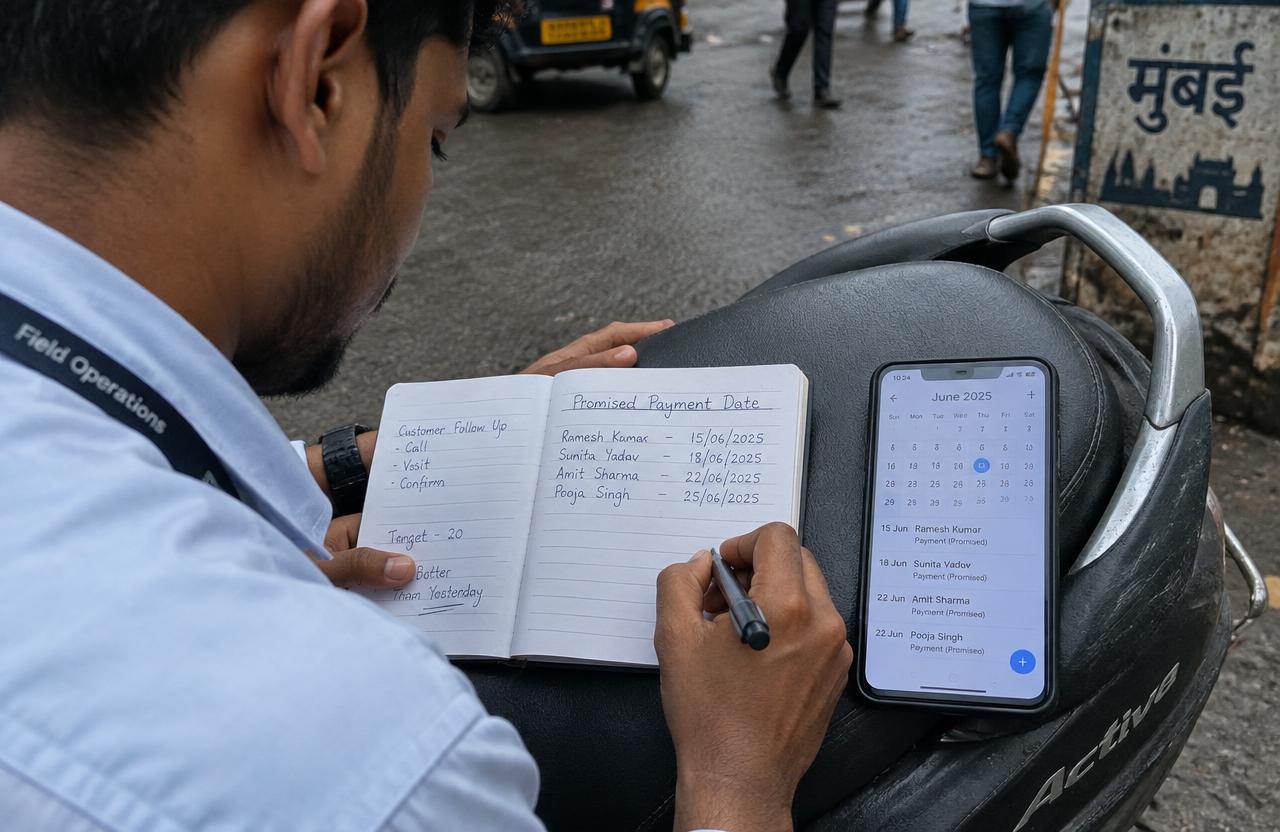
Promise-to-Pay Follow-ups is a field service in which a trained team recording repayment commitments and following up on them exactly as instructed. You share the locations and instructions; the team completes the visits, the evidence is reviewed, and you receive one consolidated report. Every collections visit is made only on the client's written authorisation, using the client's approved script and payment channels.
At a glance
- What this covers
- Every checklist point and its evidence rule
- Division
- Collections field support · Follow-ups
- Checklist points
- 5 standard checks
- Report outputs
- 4 deliverables
- Coverage
- Mumbai, Thane, Navi Mumbai, Panvel
- Read time
- 3 min
What you will learn
- Core checklist — 5 steps, in the order a field team works through them
- Evidence rules — 4 points you can lift straight into your own brief
- Turning the checklist into a field form — 5 steps, in the order a field team works through them
Core checklist
- Promise amount and date recorded — photograph or record proof
- Reminder before due date — photograph or record proof
- Visit on the promised date — photograph or record proof
- Payment confirmed or broken — photograph or record proof
- New commitment captured — photograph or record proof
Evidence rules
- Every photo carries the job ID and location ID
- Wide shot for context plus close-up for detail
- Time and location stamp kept on the file
- Unclear or missing evidence triggers a revisit
Turning the checklist into a field form
- One question per line for each of the 5 points, with a fixed answer format
- A mandatory photograph against the points that decide the outcome, starting with promise amount and date recorded
- A remarks box for anything the checklist does not cover
- An outcome code at the end of the form
- Job ID and location ID pre-filled rather than typed on site
When is a visit counted as complete?
A visit is complete only when every checklist item has an answer and the required evidence. Visits that could not be completed are marked inaccessible, with the reason, and sent to you for a revisit decision.
What you receive
- PTP tracker
- Kept / broken promise report
- Revised commitments
- Escalation list
What to share before the visits
- PTP list
- Client authorisation letter
- Approved script
Key takeaways
- A promise-to-Pay Follow-ups checklist is only useful when each of the 5 points has one fixed answer format and a matching piece of evidence.
- The checklist runs from promise amount and date recorded to new commitment captured, with evidence recorded against the points that decide the outcome.
- You receive 4 outputs: PTP tracker, Kept / broken promise report, Revised commitments, Escalation list.
- Visits are made only on your written authorisation, between 8:00 am and 7:00 pm, using your approved script and payment channels.
- Visits run across Mumbai City, the Western and Eastern Suburbs, Thane, Navi Mumbai and Panvel, and assignments typically start within one to three working days of a complete brief.
What to do next: turn the checklist into a brief
A checklist becomes an assignment the moment it has fixed wording, an evidence rule against each point and a location list behind it.
Freeze
Lock the wording of every point
Field staff answer exactly what is written. Keep all 5 points to one question with one answer format, including new commitment captured.
Evidence
Attach a photo rule to each point
A wide shot for context and a close-up for detail, both carrying the job ID and location ID so the file can be matched later.
Send
Pair it with the location list and deadline
Send the checklist together with ptp list, client authorisation letter, approved script — that is a complete brief, with nothing left to chase.
Before you send it
Starting promise-to-pay follow-ups
Collections visits are made between 8:00 am and 7:00 pm, only on written client authorisation and through your approved channels.
Share a brief and location listFrequently asked questions
What should a promise-to-Pay Follow-ups checklist include?
Promise-to-Pay Follow-ups is a field service in which a trained team recording repayment commitments and following up on them exactly as instructed. You share the locations and instructions; the team completes the visits, the evidence is reviewed, and you receive one consolidated report. Every collections visit is made only on the client's written authorisation, using the client's approved script and payment channels.
Which areas do you cover for promise-to-Pay Follow-ups?
Mumbai City, the Western and Eastern Suburbs, Thane, Navi Mumbai and Panvel, with local field teams in each area.
How fast can promise-to-Pay Follow-ups start?
Most assignments start within one to three working days of receiving a complete brief, depending on volume and spread.
What evidence will I receive?
PTP tracker and Kept / broken promise report, matched to a unique job and location ID.